What share of AI citations come from your own website? 2-6% for category queries
Four figures from three research vendors put a brand's own domain at a low single-digit share of the AI citations in its category. Local queries reverse the finding, and three widely quoted figures measure something else entirely.

Between 2% and 6% for category queries. Four figures from three research vendors put a brand's own website at a low single-digit share of the AI citations that appear when its category comes up. Ranqo measured 2.9% across 149,912 citations. AEO Labs found 2-6% and reported the range holding in every vertical it classified. Profound's analysis of 3.25 billion citations has been reported at 2.6%, and the Profound figure Microsoft Advertising quoted in March 2026 sits near 4%.
Local queries are the exception, and a large one. For location-specific queries, Yext measured 86% of citations coming from brand-influenced sources across 6.8 million citations (October 2025): the website, business listings, social profiles. Everything below describes category queries. Local queries behave in the opposite direction.
What do the datasets say?
They agree on the range and disagree on the decimal.
| Own-domain share | Sample | Source |
|---|---|---|
| 2.6% | 3.25bn citations | Profound |
| 2.9% | 149,912 citations | Ranqo, June 2026 |
| 2-6% | classified by vertical | AEO Labs |
| ~4% | not stated | Profound, via Microsoft Advertising, March 2026 |
All three vendors sell citation tracking. The convergence is real, and it also runs in the direction that suits their products, with no independent academic replication behind it. We would treat the range as well evidenced and the exact number as unsettled. Profound's own two figures differ by 1.4 points.
If your own site is under 6%, where do the other citations come from?
Mostly from other companies' pages. Ranqo published the full composition:
| Source type | Share of citations |
|---|---|
| Corporate and competitor pages | 75.2% |
| Video | 4.2% |
| Community forums, including Reddit | 3.3% |
| Your own domain | 2.9% |
| Reference sites, including Wikipedia | 2.6% |
| Software review platforms | 1.1% |
Three quarters of the citations sit on other companies' pages describing the category, competitors included. Journalists and forums together account for under 8%, which is awkward for the standard advice, since most off-site citation work points straight at them.
Profound's September 2026 analysis of 11.8 billion data points, published by WARC, points the same way from the other end. Brand websites as a class drew 57% of AI citations, 47% on ChatGPT and 69% on Gemini. That is every brand's site added together, and yours is one of them.
Which similar-looking statistics measure something else?
Three numbers get pulled into this conversation while measuring something different, and the first objection you hear will usually be one of them.
- "Earned media is 84% of AI citations" (Muck Rack, 25m links, May 2026; 85.5% in 5WPR's version). The denominator is total citation volume across all queries, not the citations in answers about one brand.
- "Only 2.6% of earned media citations come from Tier 1 publications" (27m citations). Same number as the own-domain figure by coincidence, describing the composition of earned media.
- "Baseline citation rate 7.6%, rising to ~34% with earned distribution" (Stacker pilot, December 2025). A probability that one piece of content gets cited, not a share of anything. The sample was eight stories, so it points at a lever without sizing it.
Which third-party sites does each AI engine cite?
It differs by engine. Profound's research found no universal best content type, because engines cite different source types.
| Engine | Leans on |
|---|---|
| ChatGPT | Reddit, YouTube, LinkedIn. Ignores X/Twitter |
| Gemini | Editorial and reference: Reddit, YouTube, Wikipedia |
| AI Overviews and AI Mode | Social and UGC, at roughly double Gemini's citation depth |
LinkedIn shows how fast this moves. It went from outside the top 20 to the most-cited domain for professional queries on ChatGPT between November 2025 and February 2026. ChatGPT's omission of X looks like a licensing outcome rather than a quality judgement, so it could reverse with a contract instead of a model update.
What should you do with this?
Measure your own share, then work on the pages that carry most of the citations.
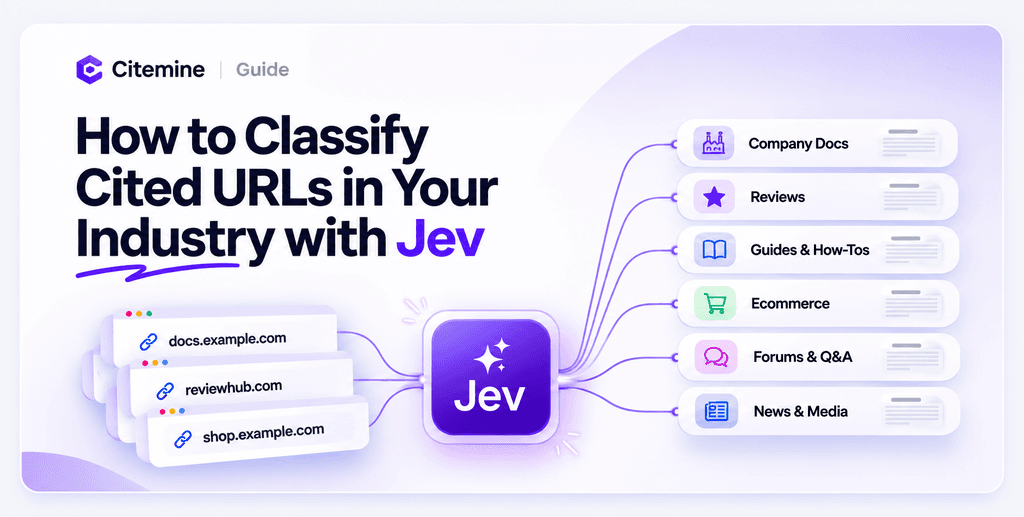
- Inventory the URLs cited in answers across your category. Classify each one by whether you own it, can influence it, or neither.
- Compute your own owned share. One number, on your own data, replacing every vendor figure above.
- Split category queries from local queries before averaging anything, because the two move in opposite directions.
- Go after the corporate and competitor pages carrying 75% of the citations, alongside the press coverage carrying a fraction of it.
- Pick the engine that matters to you and distribute accordingly: LinkedIn and Reddit for ChatGPT, reference surfaces for Gemini.
Is your business in the answer?
One report, four AI platforms, the questions your customers actually ask.